

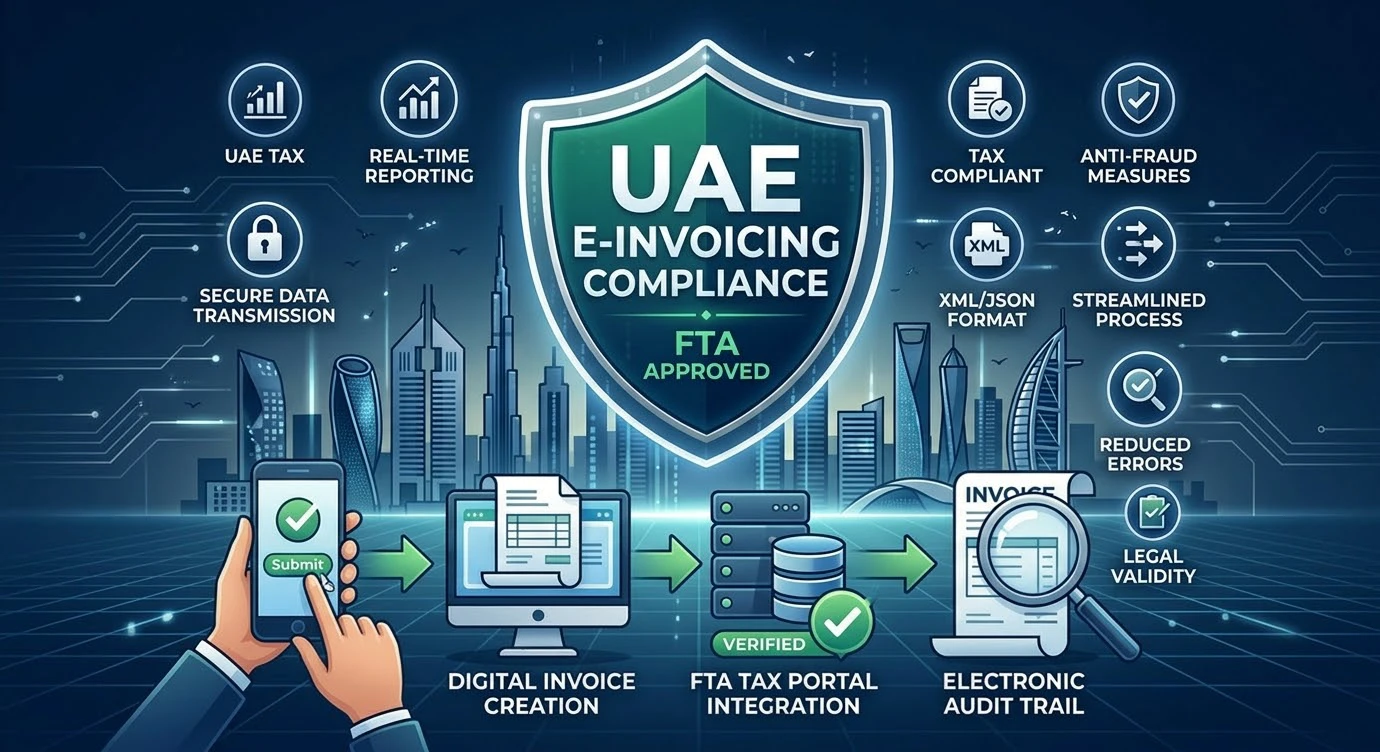
In the UAE, business-to-business invoices are undergoing a transformation. Business-to-business invoices are getting a makeover in the UAE. The new e-invoicing system will no longer suffice for most of the B2B and B2G sales as of now with only PDF and paper tax invoices. Invoices must use an approved platform for structured data, while the FTA receives tax information in near real time.
The first e-invoicing compliance deadline is soon and UAE e-invoicing compliance impacts your ERP, invoice templates, customers, suppliers, and your internal controls. By 30 October 2026, any large business will have to designate an Accredited Service Provider.
This guide explains who needs to comply, the major UAE e-invoicing deadlines, the major requirements and what you need to do right now.
What Is E-Invoicing in the UAE?
E-invoicing is the issuance, transmission and receipt of invoices in a structured electronic format, via an accredited platform, for automatic reading and validation by the systems.
An e-mail sent to a customer containing a PDF is not considered an e-invoice in the UAE e-invoice system. Neither is a Word file, a scanned copy or an image.
The legal framework mainly comes from two Ministry of Finance decisions made in September 2025:
- The scope of the e-invoicing system is in the scope of Ministerial Decision No. 243 of 2025.
- It is implemented in accordance with Ministerial Decision No. 244 of 2025.
Ministerial Decision No. 66 of 2026 then superseded Decision 244, and extended the provider appointment deadline to large businesses.
How the UAE E-Invoicing Model Works?
The UAE is based on a decentralised five-corner approach, based on the international Peppol standard. The UAE format of the invoice is known as PINT AE.
In actual practice, the flow is as follows:
- You send out the invoice via your Accredited Service Provider (ASP).
- Your ASP validates it and passes it on to your buyers ASP.
- Tax Data is reported to the FTA by both the ASPs.
- The buyer receives the invoice in his system from the buyer’s ASP.
Fifth corner is the FTA. It doesn’t approve each invoice before your customer receives it, and you can’t upload the invoices to a government portal. Your ASP will manage the exchange.
There is no transfer of responsibility if you use an ASP. Your business is still responsible for the correctness and the timeliness of the invoice information.
Businesses will be subject to E-invoicing
The UAE has a mandate for businesses in the following:
- B2B transactions (business to business).
- Transactions between companies and governments (B2G).
There is no scope for it now for B2C sales to consumers. Companies that buy invoices must also designate an ASP, just like invoice-issuing suppliers.
There are a few exclusions, including:
- Government entities that do not compete with the private sector (sovereign activities).
- Some airlines that fly passengers and/or goods overseas
- The financial services that are VAT exempt or zero-rated are:
UAE E-Invoicing Deadline: Full Timeline
The rollout is gradual according to the size of the business. Here’s the present UAE e-invoicing compliance schedule:
| Phase | Who: | ASP appointment deadline: | Mandatory from |
| Pilot and voluntary adoption | Selected taxpayers and any ready business | – | 1 July 2026 |
| Phase 1 | Businesses with revenue of AED 50 million or more | 30 October 2026 | 1 January 2027 |
| Phase 2 | Businesses with revenue below AED 50 million | 31 March 2027 | 1 July 2027 |
| Government | Government entities | 31 March 2027 | 1 October 2027 |
Large businesses had a target date of 31st July 2026 for the ASP. Feedback from businesses resulted in its modification and shifting to 30 October 2026 in May 2026. The go live date of 1 January 2027 remained unchanged. Older articles may still have the July date.
UAE E-Invoicing Deadline: 30 October 2026
Is Your Business Ready for UAE E-Invoicing?
Don’t risk AED 5,000 monthly penalties. Our experts will assess your ERP, choose the right Accredited Service Provider and get you compliant before the deadline.
Book a Free Consultation Chat on WhatsAppOr call +971 52 469 9945 | info@alberts.ae
UAE E-Invoicing Requirements
Getting right several things at once is required to meet UAE e-invoicing requirements.
1. Designate an Accredited Service Provider
You must cooperate with an ASP which has been approved by the Ministry of Finance. Before signing, compare the following ERP integrations, pricing and support.
2. Use the Required Data Format
Invoices should be based on the PINT AE specification. All required fields must be captured systematically such as:
- The words “Tax Invoice”
- Name, address and Tax Registration Number (TRN) of the supplier.
- Customer name/address and TRN (if the customer is VAT registered).
- Each invoice will have an unique, sequential number.
- Invoice Date and Supply Date (if applicable)
- Description, quantity and unit price of goods/services (products)
- Provide this information when calculating the amounts.
- Currency (VAT in AED if not used in AED)
3. Create Invoices as Per Due Date
Send e-invoices within 14 days of the date of supply. You can be penalised for late transmission on a per invoice basis.
4. Accept Credit Notes Electronically
Manage cancellation, price reduction, refunds and corrections via electronic credit notes. Don’t edit or delete the original invoice.
5. Store Records Correctly
Maintain electronic invoices according to UAE record keeping requirements, including storing them in the UAE.
6. Report System Failures
In the event you or your ASP’s system fails and it is not possible to issue e-invoices, it is required to notify the FTA within the designated time.
Penalties for Non-Compliance
The Cabinet has decided on the administrative sanctions for non-observance of e-invoicing obligations (Cabinet Decision No. 106 of 2025):
| Violation | Penalty |
| Failure to implement the system or appoint an ASP until the time limit stipulated.Failure to implement the system or to appoint ASP in time according to time limit. | AED 5,000 for each month of delay |
| Failure to issue and send an e-invoice/e-credit note on time | AED 100 per document, not to exceed AED 5,000 per month |
| Late notification of the FTA of a system failure | AED 1,000 per day |
| Failure to notify your ASP about the change of the data that has been registered | AED 1,000 each day of the delay |
Strategies for UAE E-Invoicing Compliance
Here are some steps to take to prepare for either Phase 1 or Phase 2:
- Confirm your phase: Look at the difference between annual revenue and AED 50 million to determine which deadline applies.
- Run a gap analysis: Review your ERP or accounting software and look for fields that are missing from it, compared to the PINT AE data requirements.
- Clean Your Master Data: Ensure that customer TRNs, legal names and addresses are correct. One of the most frequent causes for rejection of invoices is the presence of bad data.
- Choose and hire an ASP: Follow this procedure prior to the deadline, as outlined by the FTA.
- Integrate and test: Integrate your system with the ASP and play with real scenarios like credit notes, advance payments and foreign currency invoices.
- Train your team: It is important that Finance, Sales and IT know how the new workflow is going to work and how to deal with rejections.
- Update internal controls: Documenting approvals, exception handling and system failure procedures.
- Discuss with your customers and suppliers: Share your timeline with them, as they will also be sending and receiving e-invoices from you.
The voluntary phase is ongoing since 1 July 2026, with no penalties attached, making it a low-risk option to start testing your setup early.
Frequently Asked Questions
1. Will e-invoicing be compulsory in the UAE?
Yes, in phases. Large businesses will commence from 1 January 2027, others from 1 July 2027 and government entities from 1 October 2027.
2. When do large businesses need to implement UAE e-invoicing?
Companies that earn AED 50 million and above will need to designate an ASP by 30 October 2026 and implement by 1 January 2027.
3. What about an ASP when only receiving invoices?
Yes. An Accredited Service Provider must be had by both the issuer and the recipient of in-scope invoices.
Final Thoughts
The UAE e-invoicing compliance system and data work takes time, and it’s a significant change for every business selling to other businesses or to government. Only a few weeks remain for large companies to hire an ASP. Smaller companies should start planning now to prepare before July 2027.
This article provides general information only and information based on the rules of the Ministry of Finance and FTA up to October 2026. Conditions may evolve, so please check with the FTA or a tax expert to ensure that you are aware of the current criteria.