
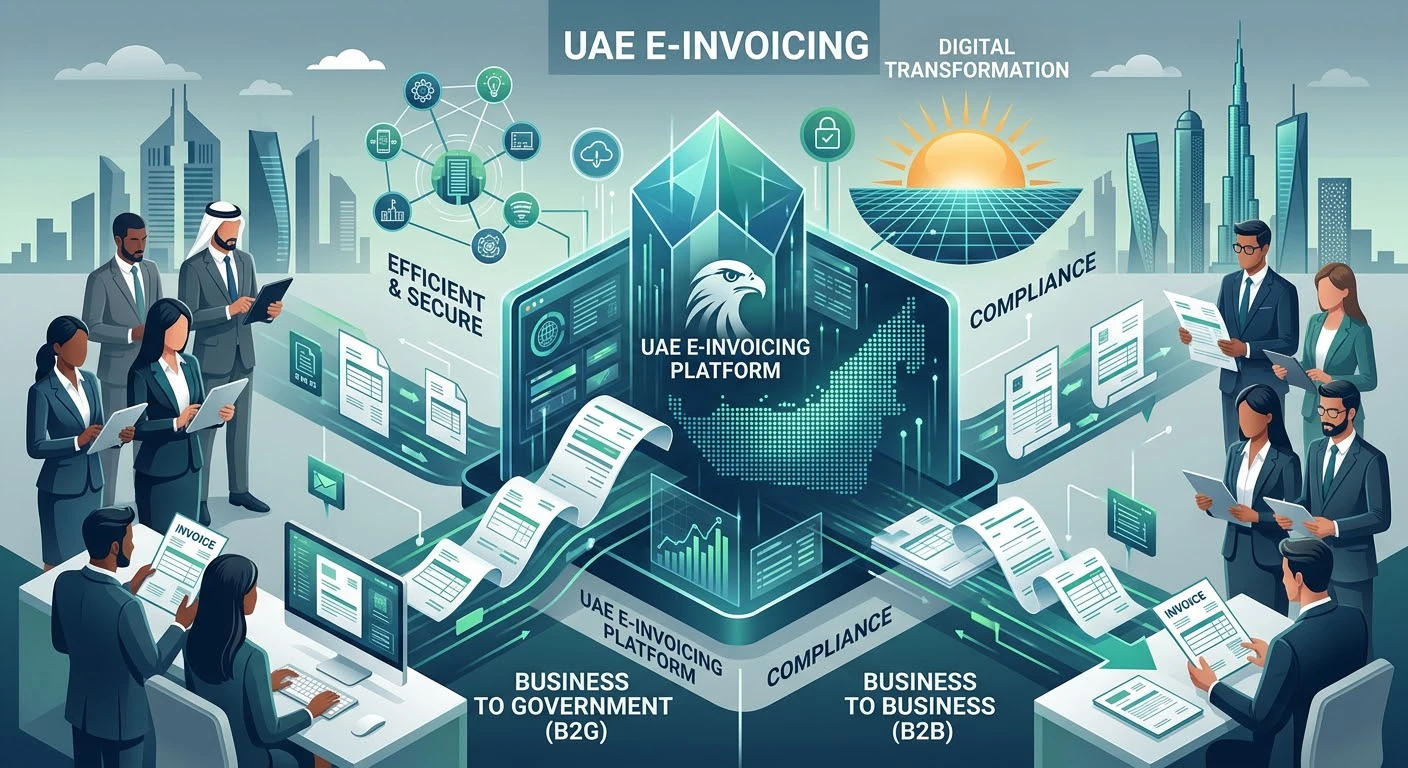
With the implementation of e-Invoicing UAE approaching, companies need to gear up for the upcoming deadlines. Most businesses in the UAE have been doing this for years: they make an invoice in PDF format, send it as an attachment to an email and sit back and wait for payment. But that is changing. Companies in the UAE are transitioning towards an electronic invoicing system, and the first deadlines are certainly not far away. For businesses operating in this region, the introduction of e-invoicing UAE isn’t something your IT department can only imagine within the realm of possibility. It’s a compliance deadline, real consequences, real process changes for your finance team.
This guide is to explain what the new system will entail, who it will affect, when it will start and how to be prepared without last minute panic.
What Is UAE E-Invoicing?
It’s important to understand that e-invoicing isn’t the same as emailing a PDF. PDF invoice is a virtual representation of an invoice. A true e-invoice contains structured data that computers can read and process automatically without manual retyping.
The UAE electronic invoicing system involves generating an invoice in a standard digital format, validating the invoice, sharing the invoice with the other business via approved systems, and submitting the invoice to the tax authority. The structured electronic invoices UAE businesses will be sending will replace manual and paper-based invoicing for covered transactions.
Legislative changes in the VAT and tax procedures laws and detailed rules provided by the Ministry of Finance set the stage. The Ministry has published Ministerial Decision No. 243, which establishes the framework for the Electronic Invoicing System, and Ministerial Decision No. 244, which establishes the rules for the implementation of the Electronic Invoicing System, on 29th September 2025.
These jointly present the UAE e-invoicing framework, including its scope, obligations and timings. Further guidance was provided, and the Ministry published detailed guidance, a list of the required invoice fields and guidance on choosing service providers in February 2026.
To Whom is the Mandate Extended?
The UAE e-invoicing mandate is targeted to transactions between business and government. The system is applicable to all persons engaged in business in the UAE, relating to business-to-business and business-to-government transactions (B2B/B2G), except for a few exemptions. It implies that both UAE B2B e-invoicing and UAE B2G e-invoicing fall under the scope of the rules. This is not the case when the sales are made to common consumers. As of now, e-invoicing is not applicable to B2C transactions. Some airline and exempt or zero-rated financial services also qualify for exclusions. Consult your advisor about your specific operations.
Some transactions may fall outside the rules, but that doesn’t disqualify you. A business can voluntarily issue and report e-invoices even in the non-excluded cases.
The UAE E-Invoicing Timeline
This is the thing that all finance managers should note on the calendar. UAE e-invoicing rollout is phased according to the size of the business.
On 1st July 2026, a taxpayer working group was launched as part of a pilot. All businesses with an annual turnover of AED 50 million and above must implement e-invoicing starting from 1st January 2027; those with annual turnover less than AED 50 million from 1st July 2027 and government bodies from 1st October 2027.
Before you go live there’s an additional step: you need to designate a service provider. It was recently extended for larger businesses. On 31st August 2026, Ministerial Decision No. 66 of 2026 extended the deadline for businesses that have achieved a turnover of AED 50 million or higher to appoint an accredited provider from 31st July 2026 to 30th October 2026. The date for appointment as provider for smaller businesses and government agencies is 31st March 2027.
If your company is a part of the larger group, the appointment is just weeks away. These UAE e-invoicing deadlines are not negotiable; otherwise, it would be a costly mistake.
How the System Works?
The UAE has opted for a model which does not require businesses to invoice one another, or directly the government. On the contrary, all the flow goes through approved intermediaries.
Accredited Service Providers
All businesses in scope require a partner. Businesses must appoint an Accredited Service Provider to process invoices and ensure every invoice includes the required information. Each of these UAE accredited service providers validates every invoice, then shares it with the buyer’s provider and finally shares the necessary information with the Federal Tax Authority e-invoicing UAE platform.
The decision on a UAE e-invoicing service provider is not a simple one. Reliability, support, and integration with existing systems are important considerations, as you’ll likely be working with the same provider for years, and changing your service provider later can prove disruptive.
Peppol and the Standard Format
The UAE system is based upon an internationally recognised network. The Peppol network, also known as the five-corner model, requires all companies to use the PINT-AE format. People e-invoicing UAE compatibility implies that invoices have a standard format, making e-invoice generation UAE and e-invoice processing UAE much more uniform than today’s variety of formats.
If You Are Not Ready then What Happens?
Penalties for the rules. Authorities will fine businesses AED 5,000 monthly for failing to implement the system or appoint an accredited provider. Other infractions, including failure to notify the tax agency of system failures, have different repercussions.
Beyond the threat of fines, there’s also a practical risk. UAE businesses use electronic tax invoices to record VAT and claim input tax. Incorrect or late invoices can delay payments and disrupt customers’ VAT claims.
How to Prepare: A Practical Approach
Companies that do this right are conceiving the UAE e-invoicing implementation as a finance and operations project, rather than a change in software.
A Readiness Assessment is the First Step
A UAE e-invoicing readiness assessment reviews your current invoice issuance and receipt processes. Who creates them? Which systems are involved? How many times do you send invoices a month and how many do suppliers send you? An e-invoicing gap analysis UAE assesses your current setup and compares it with UAE e-invoicing requirements, including mandatory data elements. Before anything else, many companies find their master data – that is, customer tax numbers, product descriptions, etc. – are not in good shape.
Review Your Systems
Now the technical side comes. Integrate your core business system with your chosen UAE e-invoicing provider to automate invoice delivery. However, for smaller businesses, accounting software automation e-invoicing integration may be more suitable, or they might instead switch to new e-invoicing software UAE that will manage the entire process. E-invoicing integration in the UAE takes time to test, so start early and avoid last-minute delays.
Ensure that the Right People Are in the Right Place
E-invoicing is not just a matter for the accounts team. Everyone from sales to procurement, IT, tax to legal has a part to play. Involve everyone early to ensure the system supports how your business operates.
Get Expert Support
Numerous businesses rely on e-invoicing consultants UAE to develop the project. Good e-invoicing advisory UAE companies assist in provider selection, data-mapping, testing and employee training. For residents of the emirate, e-invoicing implementation services Dubai vendors can also facilitate communication between your software vendor and your certified vendor. Post go-live compliance assessment ensures a successful e-invoicing implementation.
Is Your Business Ready for UAE E-Invoicing?
Deadlines are approaching fast. Get expert help with readiness assessment, provider selection, and system integration, so you stay compliant and avoid AED 5,000 monthly penalties.
Book a Free Consultation Explore E-Invoicing ServicesOr call us: +971 52 469 9945
The Benefits Beyond Compliance
Though it can seem as if e-invoicing is just another rule to adhere to, there is a silver lining to it. By introducing automated invoicing solutions UAE businesses can minimize manual data entry, decrease the chances of errors, and streamline the invoicing approval process. Suppliers receive clear, recognizable invoices and can process payments faster.
VAT invoice automation UAE also enhances the accuracy of VAT returns, as the information is already in a structured and clean format. As time went on, digital invoicing UAE helped to achieve the broader digital tax compliance UAE targets, thereby enabling businesses to become more acquainted with their own finances and drastically reducing the agony of audits.
Final Thoughts
The UAE e-invoicing compliance is being implemented in phases, but it is time to get ready now. For large businesses, provider appointment is virtually imminent and for smaller businesses there’s less than meets the eye to implement system changes, test and train.
Know your position in the UAE e-invoicing timetable, select the suitable provider, review your systems and data and seek the appropriate guidance at the earliest. Handled well, the move to UAE VAT e-invoicing isn’t just a compliance box to tick. It’s an opportunity to speed up your entire invoicing process and keep it clean, efficient, and accurate for years to come.